A Ten-Minute Reset for the End of a Busy Week
A ten-minute end-of-week reset clears one working surface, returns obvious strays, and separates unresolved items so the spot is ready for its next use.
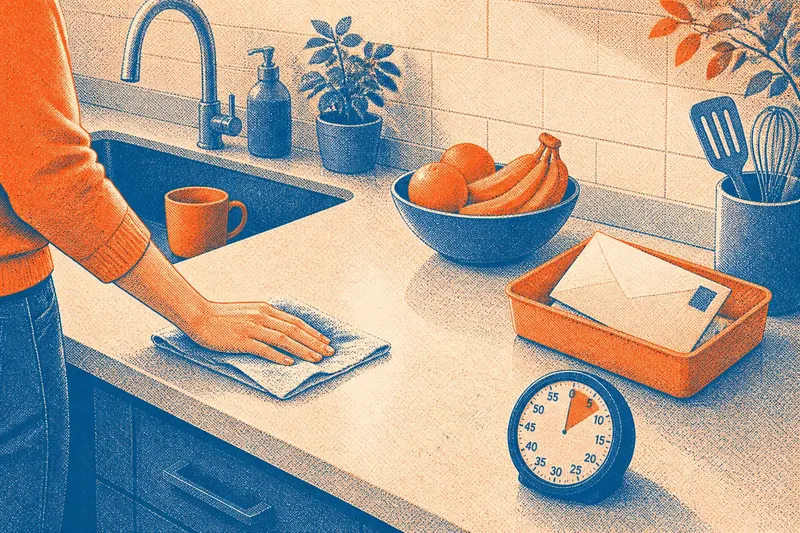
A ten-minute end-of-week reset gives one working surface a clean handoff to the next week. Set a timer, clear that surface, and leave unresolved items in a separate, visible place rather than letting them spread across the room.
Choose a surface that marks the end of a task
Pick a surface with a clear everyday job: the counter where breakfast is prepared, the entryway shelf where keys land, or the small table where incoming mail waits. The point is to reset a working zone, not to start a general tidy-up.
Before starting, decide what “ready for use” means for that spot. On a kitchen counter, it might mean an open patch for a cutting board. On an entryway shelf, it might mean a clear place for keys and a wallet. This simple standard gives the reset a visible finish.
Set a ten-minute timer on a phone, kitchen timer, or appliance clock. Treat it as a firm closing signal. Do not add another surface if you finish early, and do not extend the session because a different job catches your attention.
Make one pass for clear strays
Lift items that plainly belong elsewhere and return them only when their usual home is obvious and easy to reach. A mug can go to the sink; a paperback can go to its current reading shelf. This pass is about completing the surface’s handoff, not tracing every object through the home.
For anything that needs a decision, use one temporary holding place beside the surface, such as a shallow tray or a designated basket. Keep it separate from the area you are clearing. That way, uncertainty stays visible without occupying the spot meant for the next task.
Use this test for each item: can you name its home without searching or opening another task? If yes, return it. If no, place it in the holding spot and continue. Do not open a cupboard to reorganize it, read a stack of mail, or start laundry because a stray sock appeared.
Finish the surface for its next ordinary use
When the main strays are gone, remove crumbs, dust, or a small spill with a cloth suited to the material. Follow the surface’s care directions if you use a cleaner. Then return only the objects that support its next likely use. The goal is working room, not an empty display.
Imagine you choose the kitchen counter before the weekend, with a mug, a paperback, an envelope, and a fruit bowl on it. You put the mug in the sink and return the book to its usual shelf; the envelope has no obvious destination, so it goes in the tray. You wipe the crumbs and leave the fruit bowl with an open patch for a cutting board. The result is a counter ready for food preparation, while the envelope remains visible for a later decision.
If the timer rings while you are wiping or returning an item, stop at a safe point, put the cloth and supplies away, and leave any unresolved object in the holding spot. A brief pause at the boundary is part of the method; it prevents the reset from becoming an open-ended sequence of chores.
How should the timer and holding spot work?
Should I choose the messiest surface?
No. Choose the surface whose next use is easy to name and whose contents can be handled without opening a larger project. A smaller working zone can make a clearer handoff than a complicated pile.
What belongs in the holding spot?
Put only items that need a decision or whose usual home is unclear. If an item has an obvious home nearby, return it during the stray pass; if it needs research or sorting, keep it in the holding spot instead.
What should I do when the timer rings?
Stop adding actions and close the routine: put supplies away, keep unresolved items together, and leave the surface ready for its next use as far as the time allows. If the intended working area is still blocked, leave the remaining items in the holding spot rather than starting another task.
Does a useful surface need to be empty?
No. Keep objects that support the surface’s ordinary job, such as a key dish on an entryway shelf. Clear the space needed for the next use, not every object that happens to be there.
Keep the closing signal meaningful
At the timer, look from the position where you will use the surface next. Check whether the needed working area is open and whether unresolved items are contained in the holding spot. If both are true, the reset has made a clean handoff; if not, leave the remaining work clearly separated rather than expanding the session.
It is not worth the effort to alphabetize papers, inspect drawers, or find permanent homes for every uncertain object during this routine. The ten-minute end-of-week reset is for closing one working zone, not solving the whole household’s backlog. A visible boundary lets you return to other tasks without losing track of what still needs a decision.