When a Household Notebook and Phone Reminder Work Best Together
A household notebook and phone reminder handle different jobs: keep useful context in one place and use alerts for timely actions you might otherwise miss.
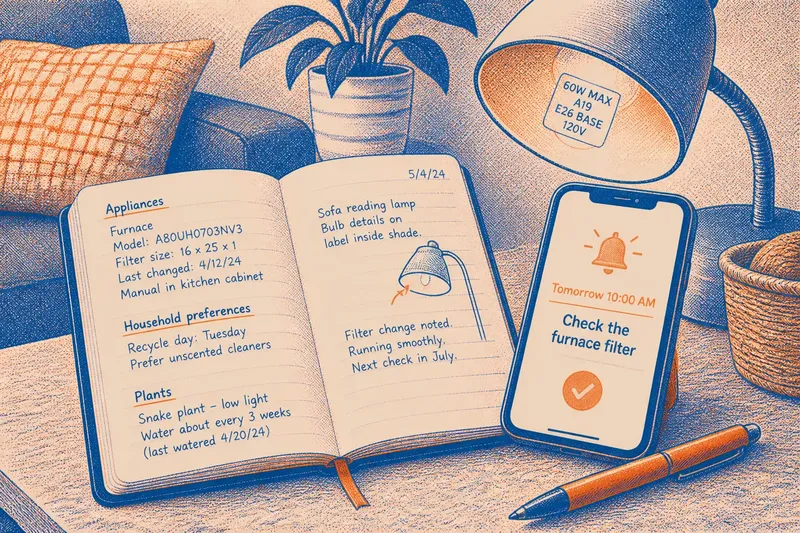
A household notebook is useful for details you will need again; a phone reminder is better for an action that must happen at a particular time. Keeping that distinction clear makes a household notebook and phone reminder work together without turning every note into an alert.
Think of the notebook as a record and the phone as a prompt. A record holds context, such as a lamp’s bulb type or the last time a filter was changed. A prompt brings a task back to your attention before a deadline or at a useful moment.
Give the notebook information that benefits from context
Write down details that could shape a later choice but do not need to interrupt you. Useful entries might include an appliance model, a household preference, or an observation about an object’s condition.
Make each note understandable on its own. “Lamp bulb” is hard to use later; “reading lamp by the sofa: bulb type shown on the label inside the shade” tells you what the note concerns and where to verify it. For instructions that can change, record the source, such as the product manual, rather than relying on a copied note as the final authority.
Leave urgent or time-sensitive obligations out of the notebook’s role. A page you must remember to open cannot reliably prompt you to meet a deadline or handle a task at the right moment.
Set up the notebook around the questions you revisit
Use a plain notebook and simple headings such as Appliances, Plants, or Household preferences. Add dates when they help you tell a current observation from an old one. There is no need to create an index or elaborate filing scheme unless you actually struggle to find a note.
- Item identification: Check whether a label or manual gives a model name or part type. If it does, record the item and where you found the detail; if it does not, note where you can inspect it later rather than guessing.
- Care observation: Check what you did and what you noticed. If the observation may affect a later decision, date it; if it is only a passing detail, leave it out.
- Household preference: Check whether the preference changes how someone should handle an item. If it does, write the preference plainly; if not, do not turn it into a standing rule.
- Unconfirmed information: Check whether the detail comes from a reliable label, instruction, or direct observation. If it is uncertain, mark it as unconfirmed and verify it before acting; otherwise, record it as a current note.
- Shared arrangement: Check whether another household member needs the information. If so, use clear wording and a location everyone can access; if not, keep the note with the person who needs it.
- Outdated entry: Check whether the item or arrangement is still current. If it has changed, cross out the old note or mark it as outdated; if it remains useful, leave it easy to find.
Use a phone reminder when timing matters
A phone reminder is the better choice when an action has a deadline or depends on a particular moment, such as taking something out before leaving home. Set the alert for the time you need to act, and give it a clear verb so the next step is obvious.
For a task with safety implications, use an appropriate alert or established safety procedure rather than relying on a notebook entry. If a device, product label, or local rule gives specific directions, follow that source; ask a qualified professional when the right action is unclear.
Connect the notebook record to the phone prompt
Use the phone to say when to act and the notebook to hold details that make the action easier. A reminder might say “check the furnace filter,” while the notebook records the equipment model, the last change, or where the manufacturer’s instructions are kept.
Say you have a reading lamp by the sofa and its bulb needs replacing. You check the label inside the shade, write “sofa reading lamp: bulb details on label inside shade” in the notebook, and set a phone reminder for the next time you plan to shop. When the alert appears, you can consult the note and verify the label instead of trying to remember which lamp needs attention. The tradeoff is simple: the notebook preserves context, while the phone brings the task back at the chosen moment.
How do you choose between a notebook and a reminder?
What belongs in a household notebook?
Record details that may help with a later decision but do not need to prompt action at a precise time. Item identifiers, shared preferences, and dated observations are common examples.
When should I use a phone reminder?
Use one when a deadline, appointment, or specific moment could be missed if you rely on memory. Write the alert as an action, such as “take the package to the door,” rather than a vague topic.
Can I use both for the same task?
Yes. Put the timing in the phone and the lasting context in the notebook. This keeps the alert brief while preserving details you may need when you act.
How can other people understand a shared notebook?
Write the item, location, and useful detail in ordinary language, and keep the notebook somewhere those people can access it. If a note concerns only one person or a private obligation, keep it in that person’s reminder system instead.
Keep only notes that help with a later choice
It is not worth recording every purchase, chore, or passing observation. A note earns space when it saves you from repeating a lookup, clarifies an arrangement, or helps you make a later decision.
When an appliance is replaced or a household agreement changes, mark the old entry as outdated or cross it out. Keep its history only if it explains a decision you may need to revisit.
A household notebook and phone reminder are most useful when each has a clear job: the notebook stores context, and the phone prompts action. The next time you repeat a household task, notice whether the missing piece is information or timing; record the first, alert yourself to the second, and verify details against their original source when they matter.