The Myth of the Perfectly Sorted Drawer
Drawer organization works best when tools are easy to find and return. Learn how to choose useful categories, dividers, and shared spaces without over-sorting.
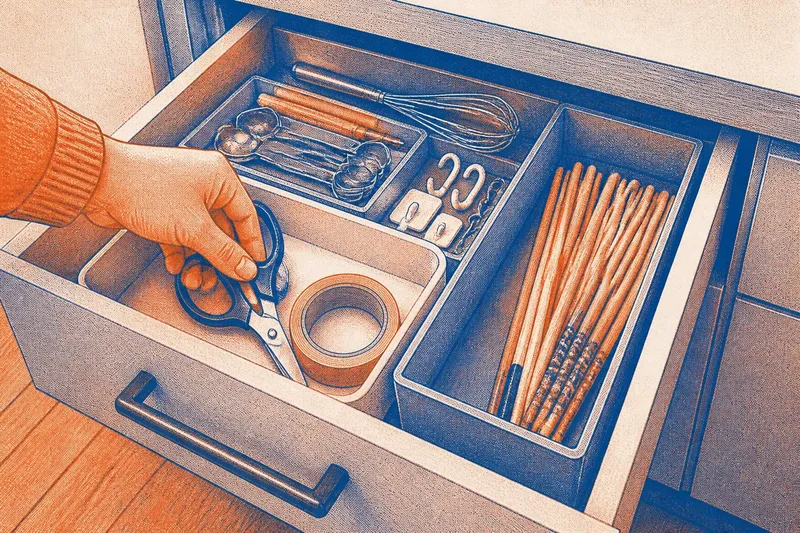
Drawer organization works best when a spatula, pair of scissors, or spare battery is easy to find and return. A drawer can look orderly from above and still fail if its dividers hide useful items or leave no easy place for them after use.
Judge drawer organization by access, not alignment
A useful drawer makes its contents easy to identify, lift out, and put back. Neat rows can help, but they are not the goal. If someone must move a stack of unrelated utensils to reach a peeler, the arrangement is getting in the way.
Think of the drawer as a small work surface. Its categories should match the task and the people doing it. “Cooking tools” may work for one household; another may prefer a visible group of measuring spoons and a separate place for knives. There is no need to make every item fit a perfect slot.
Why tidy drawers can still cause friction
Exact compartments can be awkward when objects vary in size or serve more than one purpose. A divider that neatly holds small utensils may leave a large whisk wedged across two sections. Labels can cause a similar problem if they describe the organizer’s logic rather than the words people use when searching.
Visibility matters, too. An item at the back or beneath a shallow layer can be easy to forget. If retrieving it requires lifting several other things, the drawer may technically have a place for everything while making some contents difficult to use.
Perfect symmetry is not worth pursuing when it makes storage fussy. Matching trays and narrow divisions are useful only if they improve access, prevent objects from mixing, or make returns easier.
Check the drawer while someone uses it
Look at what happens during an ordinary task. Notice where someone searches, what they move aside, and where an item lands after use. Each observation should lead to a practical decision, not a demand for a prettier arrangement.
- Find: Check whether a regular user can spot a frequently used item without searching through unrelated contents. If not, move it into view or group it with tools used for the same task; otherwise, leave its location alone.
- Reach: Check whether the item comes out without shifting several others. If not, give it more room or move it to a less crowded section; if it already lifts out easily, do not add a divider just for appearance.
- Return: Check whether there is an obvious place to put the item back. If it often stays on the counter, simplify or widen its home; if people return it easily, keep that arrangement.
- Share: Ask whether different users understand the same categories. If they search in different places, choose a plain shared label or grouping; if the categories are already clear, avoid relabeling them.
- Visibility: Check whether small or occasional items disappear beneath other objects. If they do, use a shallow tray or move them to a visible section; if they remain easy to spot, a container may add needless effort.
- Capacity: Check whether an item fits only at an exact angle. If it does, remove a divider or leave more open space; if it fits comfortably, keep the boundary.
Say you share a kitchen drawer with scissors, tape, spare hooks, and takeout chopsticks. Imagine the starting arrangement has scissors at the front, tape wedged beneath the hooks, and chopsticks loose beside them. First, move the tape and scissors into one open tray, then place the hooks and chopsticks in separate open sections using the drawer’s existing space. The expected result is that both tools are visible, the chopsticks no longer mix with the hooks, and each item has a simple place to return. If the tray crowds the scissors, leave it out and keep those tools in an open section instead.
Choose dividers for a specific job
A divider earns its space when it prevents a particular kind of confusion. A shallow tray can keep measuring spoons together and visible; a deep box may hide them beneath other contents. Large or awkward tools often work better in a broad section than in individually measured slots.
Try the drawer’s existing boundaries before buying an organizer. A clean, sturdy cardboard box can mark a temporary group, while movable dividers allow a section to expand or shrink. The useful question is what problem the organizer should solve. If no specific problem comes to mind, leave the drawer as it is.
Make shared drawer categories easy to understand
Shared drawers work best when their categories make sense to everyone who uses them. Ask other users what they look for and where they expect to find it. Different answers point to a naming or placement problem, not a failure to follow instructions.
Use plain group names. “Scissors and tape” is easier to interpret than “fix-it kit” if the drawer also holds twine and pens. Leave enough open space for an imperfect return; when an item fits only at an exact angle, someone may set it aside rather than restore the arrangement.
Questions about drawer organization?
How can I organize a drawer without buying organizers?
Group items used for the same task, then use the drawer’s existing boundaries or a clean, sturdy box to separate small groups. Keep the setup only if people can see, lift out, and return the contents comfortably.
Are drawer dividers useful?
Dividers help when small objects otherwise mix or when separate groups become easier to see. Skip them when they create cramped slots, conceal contents, or make returns more complicated.
What belongs at the front of a drawer?
Put the items people reach for most often in the clearest, least obstructed area. Occasional or backup items can go farther back if they remain visible and do not block everyday tools.
When should I change a shared drawer?
Consider a change when people repeatedly search for the same item, leave it on a nearby surface, or return it to different places. If the drawer remains easy to use, a less polished appearance alone is not a reason to reorganize it.
Change only what the drawer’s use calls for
When a repeated difficulty points to a specific mismatch, adjust that part: move a troublesome group, remove a blocking divider, or make a frequently used item easier to reach. Notice whether the search or awkward return becomes less common during ordinary use. If the change creates a new obstacle, revise it.
An occasional-use item may still deserve a place, but it need not occupy the clearest space. Move objects that belong elsewhere, without turning a drawer adjustment into a household-wide purge. Drawer organization is most useful when it respects the actual job of the drawer, even if the result looks a little irregular.